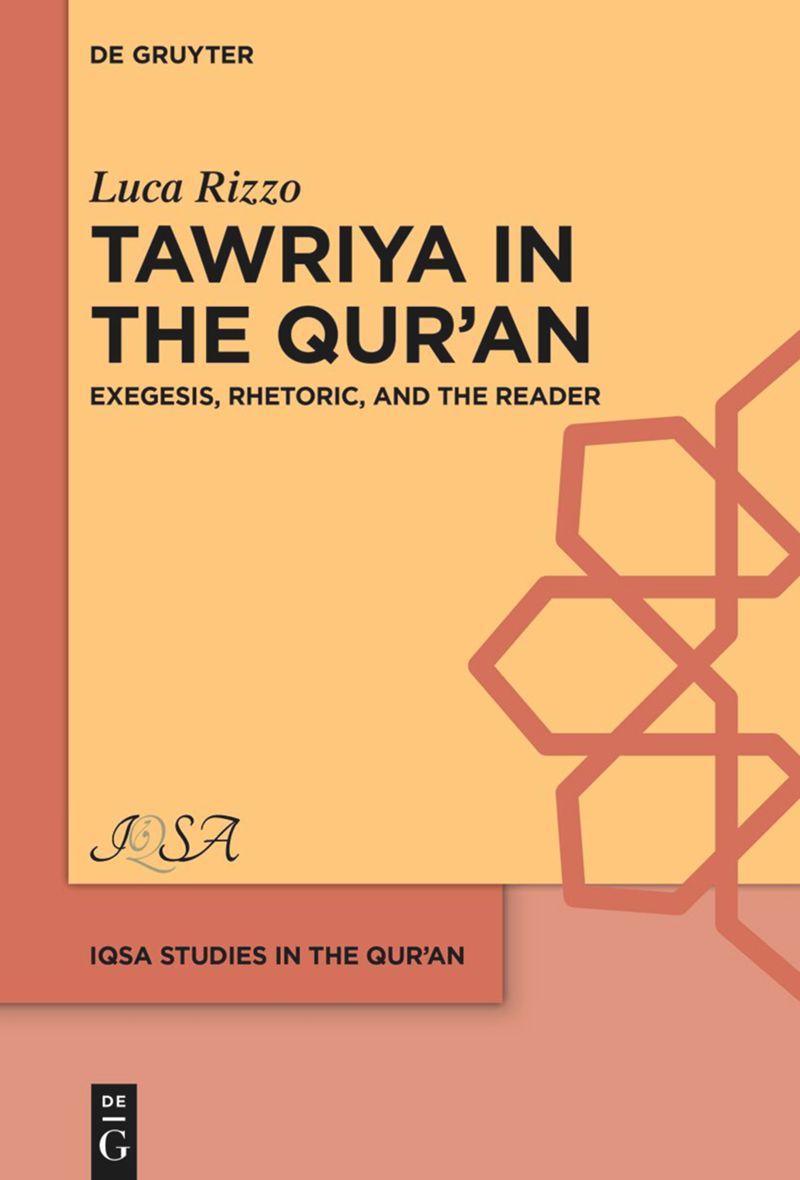
Rizzo (Luca), A Study of ›Tawriya‹ in the Qur’an. Exegesis, Rhetoric and the Reader, Berlin, De Gruyter, ("IQSA Studies in the Qurʾan ; 9") 2026, 270 p. ISBN 9783112227015
Author
Luca Rizzo is an independent researcher.
Presentation
How did premodern Muslim scholars of rhetoric and exegesis interpret ambiguous verses in the Qur’an, particularly those suggesting anthropomorphism? This book explores how the rhetorical device tawriya, or "double entendre," came to serve as a hermeneutical tool for resolving or accommodating ambiguity in the sacred text. Focusing on verses traditionally considered ambiguous (mutašābihāt) and long debated by interpreters, the study distinguishes between those not related to the nature of God and those concerning divine attributes. Through a detailed analysis of premodern exegetical and theological sources, supported by an in-depth study of rhetorical treatises, it traces the evolution of exegetical and rhetorical thought. The volume also demonstrates how tawriya was used to reconcile doctrinal concerns and to legitimise textual ambiguity. Ultimately, the study argues that tawriya reveals the centrality of the reader’s role in constructing meaning, shedding light on the dynamic relationship between rhetoric, theology, and hermeneutics in Islamic intellectual history and Qur’anic exegesis. This work is relevant for scholars of Islamic studies, rhetoric and religious hermeneutics.
Content
Contents — V
Acknowledgements — IX
List of abbreviations — XI
Romanisation of the Arabic alphabet — XIII
The opening — 1
Ambiguity in the Qur’an — 1
Qur’anic ambiguity and tawriya — 3
What is tawriya? — 5
Tawriya as part hetes — 10of the rorical tradition in modern studi
The pragmatic side of tawriya — 15
The translatability of tawriya — 18
How to approach tawriya in the Qur’an — 21
A rhetorical investigation of the Qur’an — 26
Ancient roots — 26
Modern branches — 28
Contents of this book — 32
1 The case of the non-anthropomorphic verses — 39
1.1 Ibn Abī l-Iṣbaʿ’s Taḥrīr al-taḥbīr and Badīʿ al-Qurʾān — 41
1.1.1 (Q 12:95 ḍalāli-ka: love/going astray) — 41
1.1.2 (Q 10:92 bi-badani-ka: body/coat of mail) — 43
1.1.3 (Q 2:145 qibla: direction of prayer/mediety) — 47
1.2 Al-Zarkašī’s al-Burhān fī ʿulūm al-Qurʾān — 54
1.2.1 (Q 55:6 naǧm: stars/herbage) — 55
1.2.2 (Q 3:39 miḥrāb: prayer-niche/temple, elevated room/moral status) — 56
1.2.3 (Q 88:8 nāʾima: soft/blessed) — 60
1.2.4 (Q 76:19 muḫalladūn: eternal/with earrings) — 62
1.2.5 (Q 47:6 ʿarrafa-hā: he made them know/he made them fragrant) — 64
1.2.6 (Q 5:4 mukallibīn: trained dogs/hunting animals) — 66
1.2.7(Q 9:21 wa-riḍwān: contentment/guardian of Paradise) — 68
1.2.8 (Q 2:104 rāʿi-nā: fool/listen to us) — 74
1.2.9 (Q 42:28 al-walī l-ḥamīd: God/rain) — 77
1.2.10 (Q 12:42 rabbi-hi: king of Egypt/God) — 79
1.3 Al-Suyūṭī’s al-Itqān fī ʿulūm al-Qurʾān — 82
1.3.1 (Q 34:28 kāffatan: warner/altogether) — 83
1.4 Conclusions — 85
2 The case of the anthropomorphic verses: Does God have a hand? — 93
2.1 (Q 39:67 qabḍatu-hu & bi-yamīni-hi: grip & right hand/power) — 97
2.1.1 Early interpretations in the tafsīrs — 97
2.1.2 The rhetorical turn — 106
2.1.2.1 ʿAbd al-Qāhir al-Ǧurǧānī — 107
2.1.2.2 Al-Zamaḫšarī vs. Faḫr al-Dīn al-Rāzī — 112
2.1.3 Later authors — 122
2.1.3.1 Al-Zanǧānī — 123
2.1.3.2 Ibn al-Zamalkānī — 126
2.1.3.3 Al-Qazwīnī — 128
2.1.3.4 Al-Qazwīnī’s commentators — 130
2.2 (Q 51:47 aydin: hands/might) — 136
2.2.1 Early interpretations in the tafsīrs — 137
2.2.2 The rhetorical turn — 139
2.2.2.1 Al-Qazwīnī — 139
2.2.2.2 Al-Qazwīnī’s commentators — 140
2.3 Conclusions — 143
3 The case of the anthropomorphic verses: Is God seated on a throne? — 149
3.1 (Q 20:5 ʿalà l-ʿarši stawà: sitting on the throne/dominion) — 150
3.1.1 Early interpretations in the tafsīrs — 152
3.1.2 The rhetorical turn — 157
3.1.2.1 ʿAbd al-Qāhir al-Ǧurǧānī — 157
3.1.2.2 Al-Zamaḫšarī — 159
3.1.2.3 Faḫr al-Dīn al-Rāzī — 162
3.1.2.4 Al-Sakkākī — 168
3.1.3 Later authors — 169
3.1.3.1 Al-Qazwīnī — 169
3.1.3.2 al-Ruʿaynī l-Ġarnāṭī — 170
3.1.3.3 Rukn al-Dīn al-Ǧurǧānī — 171
3.1.3.4 Al-Taftāzānī — 174
3.1.3.5 Al-Suyūṭī — 176
3.2 Conclusions — 179
4 The case of the anthropomorphic verses: The Ẓāhirite perspective on divine anthropomorphism — 185
4.1 Is there a Ẓāhirite maḏhab? — 185
4.2 Ibn Ḥazm — 192
4.2.1 On God’s hands, eyes and foot — 195
4.2.2 On “ʿalà l-ʿarši stawà” — 200
4.3 Abū Ḥayyān al-Ġarnāṭī — 207
4.3.1 On God’s hand — 208
4.3.2 On “ʿalà l-ʿarši stawà” — 211
4.4 Al-Maqrīzī — 217
4.5 Conclusions — 220
The closing — 225
Bibliography — 235
Index of Qur’anic verses — 255
Index of rhymes — 264
General index — 265