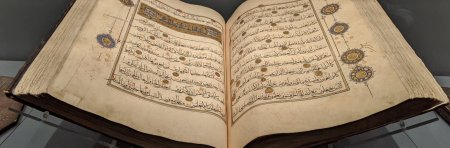
Goudarzi (Mohsen), History, Prophecy, and Revelation in the Qur’an: The Second Coming of Scripture, Oxford, Oxford University Press, ("Oxford Studies in the Abrahamic Religions") 2027, 304 p. ISBN 978-0198994312
Author
Mohsen Goudarzi is Associate Professor of Islamic Studies at Harvard Divinity School.
Mohsen Goudarzi joined the Harvard Divinity School faculty in July 2021, after previously teaching at the University of Minnesota (Twin Cities). He is a scholar of religion who studies the Qur’an and early Islamic history through literary, linguistic, comparative, and historical approaches. His work situates the Qur’an and early Islamic texts within the intellectual and social worlds of Late Antiquity and engages a range of Islamic scholarly traditions, especially the sciences of exegesis (tafsīr) and prophetic traditions (ḥadīth) (...) Goudarzi is currently working on a second book project on the role of cultic rituals, particularly those associated with the Meccan sanctuary (the Kaʿba), in shaping social interaction and religious polemic between the earliest Muslims and other religious communities of their environment. (https://www.hds.harvard.edu/people/mohsen-goudarzi)
Presentation
Scholars have often claimed that the Qur’an presents history as essentially static: a sequence of similar cycles of punishment featuring interchangeable prophets and identical revelations, with the Qur’an as the final instance. This study offers a fundamentally different account. In Goudarzi’s reconstruction, the Torah’s revelation emerges as a decisive inflection point that marks the end of ancient cycles of destruction and inaugurates a new era centered on the Torah’s recipients, the Israelites. The Torah far surpasses previous revelations: it is the first comprehensive scripture and offers extensive historical and legal instruction. The Qur’an envisions the Torah as foundational not only to the ancient Israelites but also to their Jewish and Christian heirs.
Crucially, Goudarzi contends that the Torah’s prominence and abiding significance shape the Qur’an’s self-image and message. The Qur’an presents itself as the Torah’s Arabic counterpart: the second comprehensive scripture, extending consummate divine guidance to Muhammad’s people, whom it presents as God’s chosen and Abraham’s children through Ishmael. Moreover, the Qur’an frames its instructions not as superseding those of the Torah but as largely conforming with them, even as it addresses obvious ritual and legal differences between the earliest Muslims and their Jewish contemporaries.
Goudarzi’s original account is based on systematic analysis of the Qur’an’s discourse on history and a redefinition of the central concept of kitāb as "comprehensive scripture," rather than simply "scripture" or "revelation." This argument reconfigures the Qur’anic view of history and illuminates the Prophet Muhammad’s preaching, historical context, and the emergence of Islam.
Dissertation online : https://dash.harvard.edu/entities/publication/456e0485-8f5a-4436-9095-38e937f29d46
Summary of Goudarzi’s Dissertation:
"I contend that the Qur’an envisages history primarily in a bi-modal way, that is, as having two towering moments: the revelation of the Torah to Moses and the sending down of the Qur’an to
Muhammad. This contention is based on a hypothesis that forms the analytical core of the dissertation: I argue that the Qur’an, in its discourse on revelations, uses the term kitāb not as a label for all scriptures but as an exclusive appellation for the Torah and the Qur’an. That the Qur’an applies the term kitāb to the Mosaic and Muhammadan scriptures alone, I further argue, reflects its estimation of the Torah and the Qur’an as the only scriptures that embody consummate divine guidance on
account of their comprehensive historical and legal instruction. Moreover, I show that the Qur’an ties the revelation of these two kitābs to God’s special regard for the descendants of Abraham: the Torah was sent down for the benefit of Israelites, and the Qur’an is meant primarily for the guidance of Ishmaelites. By recognizing and underlining the Qur’an’s Abrahamic exceptionalism, the dissertation recasts the significance of the Prophet Muhammad’s mission. In the qur’anic view, the mission
of Muhammad does not represent the end of a universal history of dispensations so much as it constitutes the realization of the “Abrahamic dream” for Ishmaelites and thus the second major act in the drama of the Abrahamic covenant.
The two-kitāb hypothesis and its corollaries enable fresh interpretations of many qur’anic passages, a process that has far-reaching implications for our understanding of the Qur’an. The dissertation’s final chapter outlines some of these implications. For example, I argue that the Qur’an regards not only Jews but also Christians as Israelites, that it labels both communities as ahl al-kitāb because it considers the Torah definitive to both, and that early Islam gradually lost its genealogical focus on Abraham’s descendants during the Umayyad period". M. Goudarzi (Source : https://www.jstor.org/stable/26855764?seq=4)