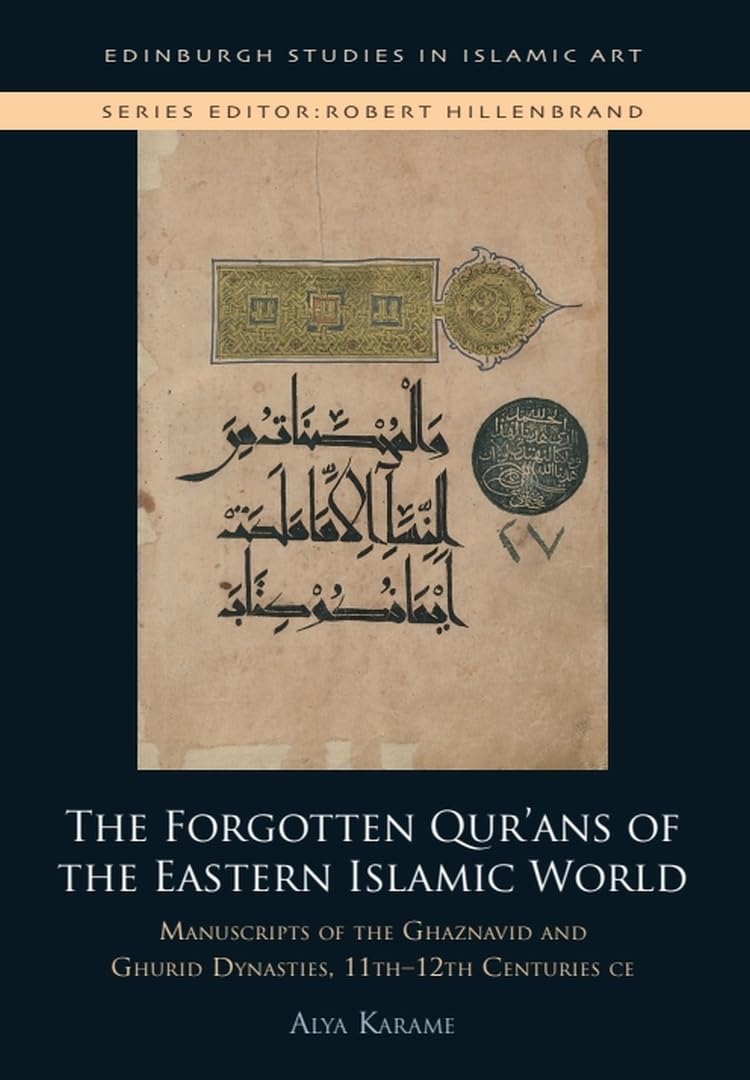
Karame (Alya), The Forgotten Qur’ans of the Eastern Islamic World. Manuscripts of the Ghaznavid and Ghurid Dynasties, 11th-12th Centuries CE, Edinburgh, ("Edinburgh Studies in Islamic Art"), 2025, 400 p. ISBN 9781399512411
Author
Alya Karame is a Research Associate at the Orient-Institut Beirut. She specialises in Islamic art and material culture, with a focus on manuscript studies. In 2023, she was a fellow of the Aga Khan Program for Islamic Architecture at Harvard University to be later supported by the Paris Région award to pursue her research at the Institut des civilisations at the Collège de France. Her work has been supported by numerous grants, including the Arab Funds for Arts and Culture and the Andrew Mellon foundation (2019-2020). She was at the Khalili Research Centre at the University of Oxford, the recipient of the Barakat Trust award (2018-2019) and prior to that she joined the Kunsthistorisches Institut research program in Florence Connecting Art Histories in the Museum and was based at the Museum of Islamic Art in Berlin (2017-2019). Karame obtained her PhD in 2018 in Islamic Art History from the University of Edinburgh and her MA in History of Art & Archaeology from the School of Oriental and African Studies.
Presentation
The first in-depth examination of the earliest corpus of Qur’ans copied at the beginning of a transformative phase in the history of Qur’an production, at the eastern frontiers of the Islamic world
Presents the first detailed study of a group of Qur’ans produced under the Ghaznavid and Ghurid dynasties
Offers the first study towards understanding a transformative phase in the history of Qur’an production
Examines Qur’ans at the eastern frontiers within the fluid transregional landscape in which their aesthetic was shaped, reclaiming ‘peripheries’ as centres of cultural production
Narrates the conception, use and role of the Qur’an manuscript across time by contextualising them, setting out a new approach, beyond codicology, for the study of manuscripts
Attributes mostly dispersed manuscripts of unknown date and origin to the medieval eastern Islamic world (950s-1250s CE) and lists them in an appendix
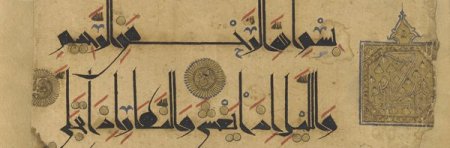
The Ghaznavid and Ghurid Qur’ans (c. eleventh–Twelfth centuries CE), studied for the first time as a corpus, inform of how the Qur’an was copied at the beginning of a transformative period in the history of its production when paper, new scripts and the vertical format were adopted. As the book illustrates the ways in which local visual trends were shaped out of diachronic and synchronic multidirectional movement within a medieval landscape that was continuously in flux, it shifts the focus to the eastern frontiers of the Islamic world, reclaiming them as centres of cultural production. It is by contextualising the Qur’an’s materiality within the religious, social and political context that the book ‘rehumanises’ them offering an understanding of how the manuscripts were conceived, produced and used, up until our day.
Contents
Acknowledgements
List of Figures, Tables and Maps
Notes for Readers
Abbreviations
Series Editor’s Foreword
Preface
Introduction
1. The First Ghaznavid Qur’ans: Alliance of Power and Religion
2. A Sultan’s Qur’an: A New Genre
3. A Royal Ghaznavid Atelier
4. Ghurid Qur’ans in a Connected World
5. A Polycentric Landscape in Khurasan and Beyond
Conclusion: From Codicology to Cultural Materiality
Appendices
1. Script and Layout Studies of the Earliest Ghaznavid Qur’ans
2. List of Qur’ans from the Medieval Eastern Islamic World, c. 950–1250 ce
Glossary
List of References
Index