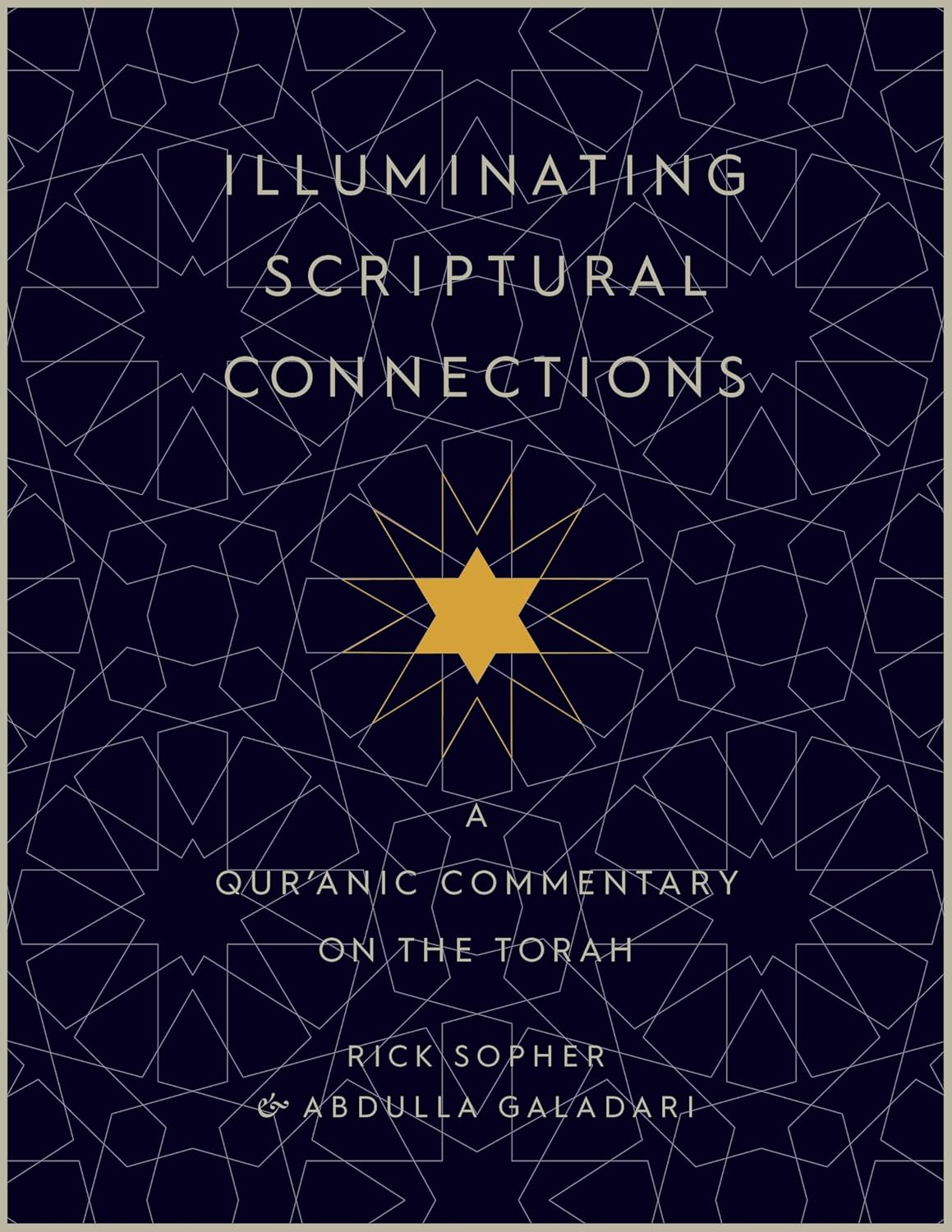
Sopher (Rick), Galadari (Abdullah) eds., Illuminating Scriptural Connections: A Qur’anic Commentary on the Torah, Melrose Park, Jewish Publication Society, 2016, 312 p. ISBN 978-0827615731
Authors
Rick Sopher is a key figure in interfaith scriptural dialogue, especially known for fostering relations between Jewish and Muslim communities. He is a fellow of the Woolf Institute, an academic institute in Cambridge, England, dedicated to the study of interfaith relations between Jews, Christians, and Muslims. In 2007 French President Jacques Chirac awarded him with the Chevalier de la Légion d’Honneur for his work in religious education.
Abdulla Galadari is an associate professor of Islamic studies at Khalifa University of Science and Technology, Abu Dhabi. He is the author of Qur’anic Hermeneutics: Between Science, History, and the Bible, Metaphors of Death and Resurrection in the Qur’an: An Intertextual Approach with Biblical and Rabbinic Literature, and Spiritual Meanings of the Ḥajj Rituals: A Philological Approach.
Presentation
Illuminating Scriptural Connections invites readers into a bold and revelatory dialogue between two of the world’s foundational scriptures. For the first time, the Torah’s fifty-four weekly portions are viewed through the lens of the Qur’an, uncovering both the variations between the two texts as well as the shared stories, prophets, principles, and visions that illuminate a deeper spiritual kinship between Judaism and Islam.
Rick Sopher and Abdulla Galadari show that the Qur’an has something meaningful to add to each weekly portion. The Qur’an designates the Torah as a source of "guidance and light" and responds to the Torah’s central narratives, from creation and prophecy to law, covenant, and divine mercy. Many commentaries compare key biblical narratives, such as Abraham’s intended sacrifice, Joseph’s life story, and Moses’s leadership, revealing the Qur’an’s perspectives. Sometimes the Qur’an upholds the Torah’s understandings; at other times it accentuates its own motifs and messages. Additionally, sometimes the Qur’an appears to engage with some early rabbinic traditions, and sometimes later Jewish literature seems to engage with the Qur’an too.
Along the way, the authors confront texts viewed as sources of tension between the two faiths. They argue that the belief that the Qur’an is hostile to all Jews is rooted in textual misunderstandings. The Qur’an both esteems certain Jews and sharply criticizes others. Muhammad’s encounters with Jewish communities, especially in Madinah later in his life, shaped the Qur’an’s portrayal.
Engaging both scripture and history, Illuminating Scriptural Connections underscores the shared linguistic heritage of Hebrew and Arabic, and challenges assumptions of opposition to demonstrate instead a profound reciprocity of ideas. It opens new spaces for interfaith understanding and connection, showing that the spiritual DNA of Judaism and Islam are intertwined far more closely than centuries of misunderstanding have allowed us to see.